Showing posts with label Sex. Show all posts

Tuesday, July 19, 2016

Book Review: The Broken Cycle


    After his many misadventures in “The Hard Way Up,” John Grimes is given a mission nobody wants with a ship captained by a guy who really doesn’t want John around. But things go off the rails pretty quick, with John and a tough lady cop stuck together in a dilly of a pickle.

A. Bertram Chandler published “The Broken Cycle” eight years later than the stories in “The Hard Way Up,” and it’s clear tastes had changed a bit, or the author had become a bit more untethered. There is some strong language and some semi-graphic sex. Where earlier Grimes stories would have been solidly PG, this book roves into more R-rated territory. And the sexism is still there, even if it’s been tempered a bit by modernity.

    The story is fast paced and mostly unexpected. There was a point where I could tell there wasn’t much left of the book, and I had NO idea how things could possibly wrap up. Often, I had no idea where Chandler was taking me. One of the strengths of these Grimes stories is they read fast. That helps to gloss over some of the shortcomings. In the case of this book, there really isn’t much story or seemingly much point. It’s just some stuff that happens. It’s kind of like a filler episode from a TV series. I don’t feel like anything of note was advanced, but it’s still perfectly enjoyable to read it while waiting for a better story (hopefully) in the next book. Had the book been longer or less readable, with no more content, it might have become a grueling slog.

    I’m taking a break from John Grimes now that I’ve finished the first omnibus in which I found this. Baen published “To the Galactic Rim” a few years ago as the first part in their complete reprinting of Chandler’s Grimes stores. Fans of classic science fiction should go get these. While I didn’t love this particular book (I enjoyed it just fine), the omnibus in general is great stuff.

-Matthew J. Constantine

Friday, January 24, 2014

Book Review: Cleopatra


“The personal inevitably trumps the political, and the erotic trumps all: We will remember that Cleopatra slept with Julius Caesar and Mark Antony long after we have forgotten what she accomplished in doing so, that she sustained a vast, rich, densely populated empire in its troubled twilight, in the name of a proud and cultivated dynasty.”

    Growing up, Ancient Egypt was something of an obsession of mine.  Like most things, I think it started with Raiders of the Lost Ark, but it blossomed into something more as time went on.  It wasn’t just digging up tombs and finding ancient bones that I found interesting, it was the lives that led to those bones, to those ruins, and those statues.  And how could I not notice Cleopatra.  Long before I knew anything about Rome and Caesar, I knew Cleopatra.  Well, I thought I did.  Over the years I’ve found that a great deal of the history we learned in school was at best shallow and at worst (sadly, most often) simply wrong.  There are countless reasons for this; not the least of which is a sort of iris through which much of the past has been distorted, the Victorian Era, when history got a prudish make-over.  But Cleopatra has been getting bad press since day one; two thousand years of having her name dragged through the mud or held aloft like a prize, depending on who was writing the books.  Stacy Schiff’s biography tries to cut through all the fluff, the rewrites, and the outright slander to get at the woman and her times.  Like with Bettany Hughes’s excellent Helen of Troy, I think one of the most striking and useful parts of this book is the recreation of the time, the context in which the person lived.


    The various conflicts throughout the lives of Cleopatra, Julius Caesar, Mark Antony, Cicero, and Octavian, among many others, help to create a tapestry of cause, effect, action, and reaction in a world on the cusp of tectonic shifts.  The end of an era, the beginning of a new.  So many players at the table, all bets were off.  The unlikely winners and losers, the highs and lows, the doomed and the destined.  The story is as rich as any novel, and as well written.  Schiff manages to dance comfortably on that fine line between recitation of facts and a novelist’s grasp of story.  And most important, these people come off as…well, people.  Men and women with goals and dreams, driven and pulled by each other and the sweep of wars and loves.  Societies going through tumultuous changes on a grand and intimate scale.  We see Rome, still a stinking warren of mud spattered buildings, still sputtering with barbaric pride.  Alexandria, refined and perhaps a bit snobbish.  Rome, with its focus on physical prowess and not too subtle anti-intellectualism.  Alexandria with its love of art and learning.  How could they not clash?  And of course, the clashes were about more than land and gold, they were about lifestyle and world view.


    Again, Schiff gives famous names their human faces.  I quickly came to like Julius Caesar, with all his many faults.  Cicero strongly reminded me of someone I knew and didn’t especially like. Cleopatra, at first clever and lucky, but eventually ruthless and powerful, a leader who knew her people, but made many enemies.  Mark Antony, a man of great passions, is as bold a hero as any bard could hope for, and as tragic.  Even knowing the history, at least in broad strokes, I couldn’t help but hope things would turn out better, that some people would win while others get their comeuppance.  Alas, this history was written in blood a long time ago.


    Of course, when trying to tell the story of Cleopatra, Schiff has a hard job of separating the truth from the propaganda.  Does she do it?  Even she isn’t sure.  Throughout the book, she reminds the reader that much has been lost, much has been exaggerated, obliterated, and intentionally obfuscated.  And always, Cleopatra, or the idea of Cleopatra, has been used as a tool.  She quickly became the “Whore of the East.”  As often happens when you have people from a more civilized, cultivated, and yes, rich place; those who are not as civilized, cultivated, or rich look upon them as pampered, decadent, and immoral.  And, when you have an conspicuously male centered society like Rome, a supremely powerful woman, in charge of that rich, cultivated nation very quickly becomes the target of the harshest slander.  Schiff doesn’t paint Cleopatra as some victimized wimp, nor as the painted trollup, nor a secret modern hero.  She was a product of her life and times, a resilient, cunning, daring, competent ruler, forged in the disasters of her early life, soaked in the blood of her enemies.  A foil to the rulers of Rome, and a historic figure of tantalizing complexity.  With all these people coming together, at the heads of great nations, it’s no wonder we’re still talking about them two thousand years later.


    If you want to see Rome through a different perspective, or just want a glimpse into the era that produced so many famous names, this book is a great read.  If you want to read a compelling story of love, loss, betrayal, politics, religion, life, and death, with murders, suicides, sex, and wild parties, this book has what you need.  And you don’t need to have a background in Roman/Egyptian history to understand or enjoy it.


"She lost a kingdom once, regained it, nearly lost it again, amassed an empire, lost it all.  A goddess as a child, a queen at eighteen, a celebrity soon thereafter, she was an object of speculation and veneration, gossip and legend, even in her own time."

Cleopatra: A Life
Author: Stacy Schiff
Publisher: Little Brown and Company
ISBN: 978-0-316-00192-2 (I listened to the audio book read by Robin Miles: 978-1-61113-915-0)

-Matthew J. Constantine

Sunday, June 30, 2013

Movie Review: Alien


    My first awareness of the Alien films came when I picked up a special Starlog magazine devoted to the then new film, Aliens.  I loved the creatures and the tech, and I would flip through the magazine time and again, without seeing the film, imagining what it all meant, building stories around the pictures.  Some years later, when we finally got a nice color TV and a VCR, I started to rent movies on occasion, and two of those early rentals (also among the first R rated films I saw) were Alien and Aliens, back to back.  That’s all it took.  I was hooked.  I loved both films.  I think for a long time, because it was faster paced and more actiony, I would have said that Aliens was my favorite between the two.  Eventually, I began to say that I loved them both, but for different reasons.  Alien was a great horror film, and Aliens was a great action movie.  I still think that’s the case.  But, I realized a couple years ago that in fact, I really, really like Aliens and I really, really LOVE Alien.  Not just a great horror film, Alien is a great film.


    In the aftermath of Star Wars, science fiction became more appealing for the folks with the money.  And, suddenly the idea of  a more ‘lived in’ future (as opposed to the ultra-clean Star Trek/2001 type futures) was acceptable.  People in space might not just be variations on our idealized astronaut heroes, but workaday schlubs just trying to get paid and get by…in space.


    After the opening titles set the creepy tone, our view slides through the halls of the ship, we see an environment where people might live or work, not too different from your office, your break room, your kitchen.  Some cryo-beds open to reveal a handful of everyday folks, a tugboat captain, his crew, and a couple surly mechanics.  Not only might I work along side any one of these people, I could very easily be one of them.  I hear echoes of myself in Yaphet Koto’s words, in Veronica Cartright, in Tom Skerrit.  And I like to think some of the best of me can be seen in John Hurt.  The point is, the film takes its time to introduce us to very relatable characters, and puts them in a very relatable environment, even if it is in space.  By this tactic, the tensions, the shocks, and the tragedy all become as relatable, thus far more effective than so many horror movies with disposable victims and vacuous ‘heroes.’


    It’s a slow burn.  About 45 minutes pass before the alien makes its first appearance.  But the tension builds and builds so effectively.  Sometimes there are jolts and jumps, mostly to give you a bit of relief.  Yet, after a brief release, it begins building once again.  Even when the trouble really gets going, there are long stretches of silence and fear.  The atmosphere is like a character unto itself, seeping into every scene, an invisible elephant in the room.  The stark terror and loneliness expressed beautifully by the cast becomes palpable.  Alien is a genuine and emotional masterpiece.


    Sexuality is both absent and ever present.  The alien itself is birth, death, and rebirth.  The tension of death and sex, penetration and embrace is lurking between the lines.  The creature is beautiful and terrifying as it is mysterious.  Is it simply an animal looking to feed and breed?  Is it intelligent?  Is it a weapon?  Is it part of some greater plan?  These are questions the movie leaves unanswered, letting you imagine a great deal.  There is a larger universe created in the film, with things far beyond our perceptions.  But sex and death transcend our ideas of civilization.  Perhaps the alien is the very embodiment of nature, giving life and taking it without regard.  Does it feel or think?  Does it look upon the humans as victims or just a warm spot to put its young?  And what evolution brought about such a thing; what is its home like?


    Alien plays with your expectations.  Who lives, who dies, when and how.  It’s all against the prevailing fashion.  As is the slow pacing and incredibly long build-up.  And I think this factor lends to its popularity and timelessness.  Alien is a movie that hasn’t aged, except maybe that the computers look primitive next to today’s ultra-mini touch screens.  Everything from the sets and costumes to the cast and script ring true.  They seem authentic.  And the alien is still one of the most beautiful things ever created for film.  It is a work of art, made more impressive by how possible it seems.


-Matt


Monday, May 6, 2013

Book Review: Night Terrors


    Author Ashley Cardiff is quite clearly completely insane.  But believe me, I mean that in the best possible way.  Her upcoming book is referred to as a ‘sex memoir’ in a couple places.  Well, that’s not quite accurate.  It’s sure not a sex guide.  Heck, though sex is one of the main topics in many if not all of the chapters, in one way or another, I don’t thing the book is actually about sex.  Well, it is.  But it’s about others stuff, too.  And it’s laugh out loud funny more often than not.

    Do ‘bad words’ bother you?  Do you get uncomfortable hearing about penises and vaginas?  If so, you should probably skip this book and focus instead on growing up.  To say it’s frank would be something of an understatement.  Cardiff is frequently quite crass, but in that exasperated way one gets when tired of talking to prudes, when you crank it to 11 to try to shake the dust off.  Her story of discovering sex in its various forms throughout childhood and her teen years is earnest and heartfelt, even while she’s coldly picking apart herself and everyone around her.


    As someone who grew up in the late 70s and 80s, in the shadow of the Cold War not the War on Terror, who still thinks of the internet as something new, and who was already painfully out of step with his own generation anyway, I found her account of growing up in the new tech age interesting.  The little things, like the internet or cell phones that are simply a part of the background, taken for granted.  Different ideas on pop culture and social changes.  Even though she’s only a generation younger than me (if I gauge her age right, and have a proper grasp on what a generation is in this day) and I have many friends of her generation, it is the first intimate, personal memoir I have read from someone younger than me, and it’s fascinating as well as seriously funny.  There are darker moments like being stuck in a destructive relationship, being taken advantage (and nearly much more) by a sexual predator, and the things one sees while walking down a nice neighborhood in New York City.  Yet no matter how ugly something was, a page later I’d be laughing at her awkward frustration at being thought a homophobe because she didn’t like a gay man (not because he was gay, but because he was an asshole), her unpleasant relationships with significant others’ parents, her philosophical wrestling with pubic hair, and the time she almost got tricked into an orgy.

    The book trails off a bit in the final chapters as she seems to halfheartedly attempt to excuse her decision to write the book in the first place, drops a few hints about hopes for the future, etc.  But it’s still a completely readable and fun book, with a great deal of the nitty-gritty, uncomfortable and stupid things we do to each other and to ourselves in the pursuit of and fear of love, sex, and human connections.


Night Terrors: Sex, Dating, Puberty, and Other Alarming Things
Author: Ashley Cardiff
Publisher: Gotham Books
ISBN: 978-1-592-40786-6

-Matt

Monday, March 11, 2013

Five Books About Movies


I love books.  I love movies.  I guess it’s no surprise I’ve enjoyed some books about movies.  There are plenty out there, from those 501 movies you must see to consummate tool Leonard Malton’s book of reviews.  And in this day of the internet, you’ve obviously got a lot of places to turn to for info on movies.  But sometimes it’s just fun to pick up a book, flip through the pages and get inspired to check out something new.  These books have led me to some great (and awful) movies, and I recommend them for any film buff’s bookshelf.

Out of the Past- Adventures in Film Noir by Barry Gifford:  The writer behind some truly weird and awesome books like Night People and Wild at Heart, Barry Gifford is also the co-writer of one of my favorite films, Lost Highway.  With this book, he discusses his love of Noir.  Like me, he has wide and liberal view of what counts as Noir.  So, you’ll occasionally get movies like Night Moves (1975) or King Creole (yes, the 1958 Elvis vehicle), along side more typical entries like Pickup on South Street (1953) and Dark Passage (1947).  Gifford’s reviews are sometimes vague, half remembered notions of films he once saw, recollected while sitting in a café somewhere.  He was not sitting in a darkened screening room, scribbling away as he watched.  So, there are times when he gets things wrong, left with impressions not actually true to the film.  It’s like someone telling you about a movie they watched a few weeks back, getting to a few of the details that really struck them, but maybe getting the order of events wrong, or having missed a bit of dialog, thinking an action meant something totally different.  But, the love of the movies is there.  And he makes you want to check them all out.  Even the ones he didn’t really like.  I’ve gone on to watch a whole bunch of movies from this book.  Some I’m sure I’d have seen anyway, but others I may have never even heard of.  And if you’re gonna watch Lost Highway, you should probably watch 1944’s Double Indemnity.  (ISBN: 978-1-578-06290-4)


Immoral Tales- European Sex and Horror Movies 1956-1984 by Cathal Tohill & Pete Tombs:  Europeans have had a strange love affair with film.  And I’ll admit it.  Most of the time I just don’t understand.  There was a time (in my teens and early 20s) when I dug really nasty gore films, which led me to watch a lot of Italian movies from the 70s.  And there was a time (circa 1981 to…well today) when I really enjoyed seeing women in various stages of undress.  Again, this led me to watch a lot of Italian movies from the 70s, as well as French films, Dutch films, UK films, etc.  But one of the reasons I moved away from European movies in general was the combination of those two things.  I got sick of seeing beautiful women mutilated, often in sort of sexual ways (cutting off naked breasts being a particularly common event in Italian horror).  And just generally, the way European film tended to treat women and sexuality started to genuinely bother me.  In French film, the men are frequently hideous middle aged ogres, while the women are comely and young.  Even when they’re not being raped, there’s a very rapey vibe to things.  But when I acquired Immoral Tales, I had yet to drift away from Euro-horror.  The book is packed with pictures that capture a lot of the WTF? nature of these films, in spite of being mostly in black & white.  The write-ups on these movies are informative, not only with lurid descriptions of movie content, but also with contextual references about the times they were being made and released, and about the people in front of and behind the cameras.  There are chapters on certain countries’ work (France, Italy, etc.) and on certain filmmakers (Jess Franco, Walerian Borowczyk, etc.).  And going back to the book now is nice, as I have developed an appreciation for the works of Jean Rollin I certainly didn’t (and likely couldn’t) have when I first got this book.  Rollin has lured me back into Euro-sleaze of the that era in part because while his films features some blood (and occasionally some gore), violence, and plenty of sex, there doesn’t seem to be that ugly sexual violence so common in that time.  Over the last couple years, I’ve found myself getting in tune with Rollin’s dream-logic storytelling.  And reading up on him as I flip through Immoral Tales again, I want to check out some more of his movies, and maybe revisit some I’ve already seen.  But this brings up a frustrating fact with all of the books on this list.  Often, outside of expensive purchases online, or lucky strikes, many movies discussed in these pages are near impossible to find.  I’ve lucked into some on NetFlix and other such places.  A few I’ve even found in stores.  But a lot of them still exist in some netherworld for me, beyond my reach.  And dropping serious dough on unseen movies isn’t a good idea, even when the review is glowing.  For example, Le bete, which sounded like it would be pretty danged amazing, turned out to be super dull.  $30 dollars I wouldn’t get back for something I watched once and would not be returning to.  (ISBN: 978-0312-1-35195)


My Year of Flops by Nathan Rabin:  The newest book on this list, I had an absolute blast reading it.  Rabin is a guy about my age, with a very similar outlook on movies.  Like me, he loves ‘em.  He even loves the ones he hates.  Maybe especially the ones he hates.  With his rating system of Failure, Fiasco, or Secret Success, he gets to the heart of movie flops.  Great movies nobody ever saw, like The Rocketeer, amazing disasterpieces like Heaven’s Gate, and all bookended by the strange cast of Elizabethtown.  His reviews are often hysterical, expletive heavy, and referential.  But he also has a lot of information to pass on, even getting the straight dope from some of the people involved in making some of these bombs.  Again, for anyone who loves movies, a must read.  Flops are a part of the magic of movies, and this book is a celebration of that magic.  (ISBN: 978-1-4391-5312-3)


Sex and Zen & A Bullet in the Head- The Essential Guide to Hong Kong’s Mind-Bending Films by Stefan Hammond & Mike Wilkins:  I used to catch bits of marital arts on TV and in movies, and sometime in my teens, a friend showed me a few classic Shaw Brothers films.  But truth be told, I didn’t get consciously into Martial Arts cinema until I saw Jackie Chan’s Rumble in the Bronx at a local theater.  Around the same time, I started watching some Gong Li movies on video, mainly because she was so beautiful on the VHS covers.  Eventually, I started to realize that Hong Kong was a happenin’ berg, and putting out some of the strangest, coolest movies.  I began consuming everything I could find at my local video stores.  As my newfound fascination with the HK film industry grew to new heights over the latter part of the 90s, I was rewarded by a one-two punch of The Matrix and Crouching Tiger, Hidden Dragon, which really pushed some of that Hong Kong style into American cinemas like never before.  And suddenly, the video market exploded with new and old titles for sale and rent.  This book came to my attention right around that time, and has served as a handy guide ever since.  Though it’s kind of out of date now (as these books are destined to become), it features some fairly in depth explorations of various movies, focused on the so called Hong Kong New Wave of the 80s and 90s.  An energy gripped movie makers, drawing on the film language of the West and on cultural changes in Hong Kong.  Out of that energy came a sort of neo-Noir, realism, and a rediscovery of Chinese classics.  The book covers everything from Jackie Chan and Jet Li movies to early Wong Kar-wai, to the difficulty created by actors having multiple names, to the often hilariously awkward subtitle translations (“He wants to be the toppest fight, shit!”).  If you’re interested in Honk Kong cinema, or just want suggestions for something a little different, this book is a must.  There are books out there that focus on martial arts, or on solitary figures like Bruce Lee, but this one gives you a nice sample from across the wide spectrum of genre, even if only from a limited time period.  (ISBN: 978-0-6848-0341-8)


Lurker in the Lobby- A Guide to the Cinema of H.P. Lovecraft by Andrew Migliore and John Strysik:  It’s no secret I’m a fan of pulp horror/sci-fi writer H.P. Lovecraft.  I love his soul blasting revelations of insignificance in the face of things so far outside human understanding his heroes often find themselves able only to escape through madness or death.  Though his stories typically dwell primarily in the minds of his protagonists, I’ve always felt they could make for excellent films.  Certainly, his concepts and themes do and have.  From direct adaptations like Re-animator (1985) and The Call of Cthulhu (2005) to thematic descendants like Alien (1979) and The Quatermass Xperiment, the book covers a lot of movies from way back all the way up to recent years.  It also gets into TV episodes (including The Real Ghostbusters!) and short films.  And there are a few extensive interviews with filmmakers and actors like Jeffery Combs, Guillermo del Toro, and the late Dan O’Bannon.  Plenty of illustrations and photographs give tantalizing glimpses at the various movies.  Annoyingly, like the above books, many of these films are difficult to come by without dropping some serious bank, or attending distant horror conventions.  Still, it’s a helpful look at some of the many movies influenced or directly inspired by a literary master and his fellows.  (ISBN: 978-1-892-38935-0)


-Matt

Tuesday, February 7, 2012

Matt’s Week in Dork! (1/29/12-2/4/12)


    I feel like my week was ruled by T&A.  It wasn’t really intentional, and I guess I can’t complain.  Plus, it was bookended by some cool classics.  I sure did get a lot watched this week.   

Not of this Earth:  “Don’t be a drag.  You know how you flip me.”  Who’s that man murdering those happening kids?  Find out in this Corman alien invasion flick.  It’s a gas.  Crazy.  Sadly Dick Miller’s supporting role is all too brief.  But this movie is a great deal of wacky 50s fun.  Aliens want our blood, and they’re willing to hire any two-bit hood to get it.  The movie is actually pretty good for this sort of thing.


War of the Satellites:  Roger Corman brings us another low budget space age adventure.  The efforts of Humanity to explore space run afoul of aliens who don’t want us mussing up their neighborhood.  But, when the lead scientist on the project (Sean Connery and Raymond Burr’s love child) starts acting funny, Dick Miller is on the case.  One of the better alien possession movies, helped a lot by a good cast.  The special effects are awkward, but interesting.


Girl Slaves of Morgana Le Fay:  Oh, to have been a filmmaker in France in the early 1970s.  This movie actually makes a whole heck of a lot more sense than your average Jean Rollin film, but manages to keep a similar vibe and is chock full o’nudity.  While I wouldn’t say the film is lighthearted, it isn’t as dark or violent as a typical Italian film of the same type and era.  The women are attractive, and from an era before the over abundance of tattoos and plastic surgery.  I was expecting a horror film, but it’s really more of a fantasy.  Worth checking out if you enjoy this sort of thing.  The disk also has a short film that’s also worth seeing.


Electronic Lover:  Something Weird’s list of cheap, odd movies of yesteryear features plenty of forgotten movies.  Often forgotten for a reason.  Other than a couple attractive women taking their clothes off, this film has nothing going for it.  It’s pretty tedious.


The Spy Who Came:  Another ‘classic’ from Something Weird, this movie is instantly forgettable.  There’s some stuff about women being brainwashed.  Lots of awkward…well, everything in the movie is awkward.  Nothing to recommend.


The Woman in Black:  Brad scored us tickets to an advance screening of this movie, which was pretty cool.  OK, so anyone who knows my movie tastes knows that I’m not a fan of either ghost stories or possession stories, as a rule.  I find them dull.  They’re played out; almost as much as vampires…maybe more, actually.  Well, this film doesn’t change my mind on that issue.  That said, for ghost story, it’s quite well done.  The movie looks great.  The actors all put in fine performances.   Sets and costumes all look great.  There is mood and atmosphere like nobody’s business.  But, at the end of the day, it’s the same ghost story you’ve seen a hundred times before.  I enjoyed the film, mostly for everything but the story.  And it really is the first of the new Hammer films that actually feels like a Hammer film.  All it needs is a buxom young lass and an appearance from Christopher Lee, and you’d swear it was 1972.  Even Daniel Radcliffe fits the mold perfectly.  The image of him with the candle and axe walking down the dark corridor should grace every movie poster (painted, not photoshopped).  Here’s hoping this is finally the hit the reborn Hammer needs to start making more and better (and more of their specific style) movies.


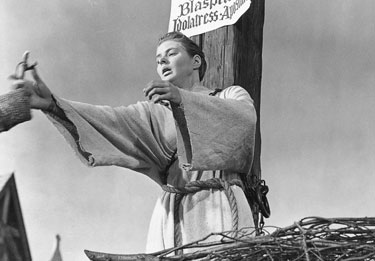
Joan of Arc:  Ingrid Bergman looks sincere, stares intently, and makes vaguely Shakespearian sounding speeches.  Sadly, she has virtually nothing to work with, as the script gives Joan absolutely no depth, making her the figurehead the film’s military leaders suspect her of being.  The only really interesting person in the film is Jose Ferrer’s skeevy royal (for which he deservedly won a supporting Oscar).  The movie takes on the typical smugness so common in religious themed films of the era.  And it quickly becomes tiresome.  I love Bergman, but not here.  This film is grueling, and feels about as historically accurate as your average non-WWII ‘documentary’ on the History Channel (read: not).


Wings:  Some really amazing flying footage, surprisingly brutal violence, and a solid story keep this film from ever bogging down.  A true epic, and one of the best WWI movies I’ve seen, focusing on the air, but not ignoring the ground.  A must see for fans of classic film.  Unlike Hell’s Angels, the downtime between dogfights doesn’t drag.  And I really enjoyed the various actors, although I found Clara Bow a bit much (cute as a button in that military get-up, though).  Still, that was sort of her shtick.  This first film to win a Best Picture Oscar is a heck of a thing.  Check it out.


Grapes of Death:  Jean Rollin strikes again.  This time, pesticide seems to be making anyone drinking the French recommended daily intake of wine mutate and turn homicidal.  Actually, though it features much of the requisite Rollin scenes of pretty young women wandering aimlessly, this one has a more consistent plot than most of his work.  It still features his usual dreamy quality, and of course, Brigitte Lahaie shows up and takes off all her clothes.  As usual, the ending breaks down into silliness and nonsense.  Still, enjoyable if you’re in the mood for Rollin’s specific brand of weirdass French pseudo-horror.  Less skin than usual for his work (even Lahaie is only nude for a moment).


Picasso Trigger:  I guess busty women just like to shower more.  That’s what this movie taught me.  Oh, and that it’s a good idea to keep reminding the viewer what day it is.  The third in the epic series that began with Malibu Express, this spy caper gives James Bond a run for his money.  Thrilling action, clever dialog, and…Oh, wait.  It’s just a stupid T&A movie with lots of terrible acting and goofiness.  If you enjoyed the first two movies (Malibu Express and Hard Ticket to Hawaii), you should enjoy this slice of stupid pie.


Savage Beach:  I love how these movies keep recycling the same actors in different roles.  Most of the people from Picasso Trigger are back.  And boy, these ladies love to take showers and/or hit the Jacuzzi.  This fourth film in the amazing, powerful, thoughtful, and heartbreaking franchise continues to break new ground.  As sensitive, thought provoking, and challenging as any film of its type, how it managed to be ignored by the Oscars is beyond me.  Politics, man.  Politics.  If nothing else, the sweeping score provided by that keyboard I had in junior high should have been nominated.


Cat People:  A beautiful film, it looks almost like a Noir.  The actors are all top notch, and the script is clever, subtle, and sexy.  There is a complexity in the characters that is surprising for B pictures of that time.  The lighting on the film is amazing.  And what’s interesting is how much isn’t shown.  How much is implied.  Is any of it real at all?  Absolutely a must see for fans of horror films.


The Curse of the Cat People:  The extremely odd sequel to the hit film Cat People, this is more fantasy than horror.  Not at all the sort of movie you’d expect to follow up the first.  But, it’s quite good.  A meditation on a lonely childhood and dysfunctional family life.  It’s more about lost people than anything supernatural.


    Ben and I watched another episode of From the Earth to the Moon.  Really a darned fine show.  As much as I love Band of Brothers, I kind of wish this was the show the History Channel would play marathons of every other weekend.

That's swell!

    I got some reading done, too.  First up was a novella (?) from Poul Anderson’s Technic Civilization series called The Saturn Game.  It was interesting.  Kind of took the idea of roleplaying games and ran with it, making it a sanity maintaining tool for long term space exploration, though with a cautionary element.  I also read a cool Star Trek graphic novel and the first two trade volumes of Boom! Studios’ new Hellraiser comic (volume 1 & volume 2).


    In addition to all that, I posted a fairly extensive Prodigal Son, which started out as simply an essay about science fiction books, and turned into something about gaming, too.  Got me to thinking about a bunch of ideas I’ve had and wanted to use for a while.


-Matt

Saturday, January 21, 2012

A Fistful of Cat-Suits! (Matt's Picks)


    Look, I’m just a hairless ape with delusions of civility.  Oh sure, I play at being classy.  But, while I try to put on the mask of Man, my core is still the Beast.  I’m not simple, but by the same token, I’m not especially complex.  I like women.  And I like ‘em sexy.  And one thing I’ve always found darned sexy is a nice cat-suit or jumpsuit.  I don’t know what it is.  Never really understood it.  But there it is.  Women pilots in a flight suits?  Cool.  April O’Neal in that yellow thing she had in the cartoon?  Awesome.  Heck, as a lad, I drooled over Troi on Next Gen all the time (before I realized how stupid, useless, and annoying she was).  And if I’d been 10 or if the show hadn’t been written by drunken chimps, I might have watched Voyager just for 7 of 9’s crazy silver getup.  So, after that awkward glimpse into my noggin, here’s a list of a few of my favorite ladies in cat-suits. 

5.  Liz Hurley as Vanessa Kensington in Austin Powers.  If I’m ever frozen for 30 or 40 years, thawed out, and told my longtime enemy needs killing, I hope cat-suited Liz Hurley is there to show me the way, engage in occasional wordplay, and put up with my periods of crass, old timey cultural confusion.


4.  Angelina Jolie as Lara Croft in Tomb Raider.  Back when Jolie still enjoyed eating (and didn’t look like a famine victim), she could sure fill out a costume.  Her sexy wetsuit makes me want to raid a few tombs…er…dig for treasure…um, I mean…have sex with her…if you know what I mean.


3.  Carrie Anne Moss as Trinity in The Matrix.  Maybe she’s not the most attractive woman.  But you throw her in head-to-toe leather or vinyl, have her do a couple acrobatic kicks, and blow something up behind her, suddenly Trinity becomes a violent action goddess.  Why do I doubt most lady hackers are up to this sort of business?


2.  Erin Gray as Wilma Deering in Buck Rogers.  Oh, man.  Young Matt was head over heels in love with this woman.  Every time I got the chance, I’d sit down and watch cool dude Gill Gerard get shot into the future where he could hang out with ultra-sexy Wilma and her amazing, form fitting uniforms.  I don’t know for sure if it was her or Wonder Woman who was my first crush.  But whatever the case, she’s had a lifelong effect on the wiring in my head for what I find attractive (read: smart, tough chicks in sexy uniforms).


1.  Dianna Rigg as Emma Peel in The Avengers.  Sweet momma, she makes the sleaziest costumes look classy.  Rigg had an amazing quality.  Somehow aloof in the most British of ways, yet seemingly willing to lower her standards enough for you to have a chance.  A dancer’s grace with a soldier’s strength and a philosopher’s mind.  All wrapped in leather and mysterious danger.  Hot.


-Matt
Thursday, December 15, 2011

Two Fistfuls of Sexy Women! (Matt’s Picks)


    OK, so the recent poll that awarded Jennifer Aniston the title ‘sexiest woman of all time’ got me to thinking.  What!?  Are you flippin’ kidding me?  OK.  OK.  I know taste and beauty are totally subjective.  But hang on.  What?!


    So, after bouncing the idea off co-Dork Brad, we decided to put together our individual top ten lists of sexiest women (that’s right, a special double-Fistful this week).  Hard as it was, I left off my first crushes.  Erin Gray, Lynda Carter, Nichelle Nichols, Karen Allen, and Lea Thompson will have to wait for another list.  I also had to skip long time crush Angela Bassett, because my feelings for her are based almost entirely on the film Strange Days, and that’s not enough.  Same with Mathilday May from Lifeforce.  Just to help narrow the field, I restricted myself to movies and TV (no music, models, etc.).  Give me another ten years for some perspective, and newer potentials like Olga Kurylenko and Shu Qi, might end up on the list.  Time will tell.


***


10.  Cate Blanchett:  OK, yeah, so Australian accents have always done something for me.  But, getting beyond that, Blanchett’s strange beauty has been fascinating since I first saw her in Elizabeth.  She has consistently turned in interesting, frequently strong performances, which can be all too rare for women in film these days.  She even played one of my all time favorites (and number 9 on this list), capturing not just her mannerisms, but her fire.


9.  Katharine Hepburn:  Though many of her most famous roles came when she was older, and had segued from young firebrand into tough spinster, young Katharine Hepburn was actually a strikingly beautiful woman who oozed confidence and style.  Her screen persona is exactly the kind of woman I like, powerful, willful, and maybe a bit brash, but soft in all the right places.


8.  Lena Olin:  OK, I admit it.  I’m a square.  I’m one of those suckers that gets in over his head in a classic Noir film.  That’s one reason I recognize the danger of Lena Olin.  She has some femme fatale power that punches through my ‘good guy’ ways and makes me want to do bad things.  From her voice to that deadly predator look in her eyes, I don’t know that I’d do any better than Depp if she wanted something I had.  Even if she cut off her own arm (seriously, this woman has played some crazy characters). 


7.  Jennifer Connelly:  I kind of grew up with Jennifer Connelly.  She’s about my age, and has been acting for a long time.  As a kid, I connected with her in Labyrinth (and yes, had a crush on her).  As an adult, I enjoyed her retro-fueled performances in The Rocketeer and Dark City.  And was weirded out by scary stuff like Requiem for a Dream.  With classic, almost timeless features, a willingness to take chances, and a pretty wide range, Connelly may not have the tabloid glitz of many modern starlets, but she’s got what counts.


6.  Gloria Grahame:  I’ve said this before, but never has a woman so not my type been so my type.  Usually bottle blond, with an upturned nose and a bit of a sour face, she manages to burn with a volcanic rage in one film and radiate innocent sweetness in another.  Her sly cleverness and dangerous curiosity in In a Lonely Place alone would have been enough for me. 


5.  Pam Grier:  The Queen of Blaxploitation, Pam Grier is a powerhouse.  With a career that has spanned decades, she’s had ups and downs, highs and lows.  But she’s always brought the goods.  From Coffy to Jackie Brown and beyond, Ms. Grier will always hold a special place in my heart.


4.  Michelle Yeoh:  A marginal actress who was only kinda cute, Michelle Yeoh could have faded away, becoming a footnote on the history of 80s martial arts films.  She got married.  She retired.  Forgotten.  But, she didn’t stay gone.  After separating from her husband, she came back to acting in a big way, and age had been more than kind.  Year by year, she grew more and more beautiful, while honing her skills as an actress, not to mention as a martial arts movie extraordinaire.


3.  Jenny Agutter:  Perhaps not classically beautiful, Agutter is extremely cute and devilishly sexy at the same time.  Giant eyes, sexy accent, and, well, she’s never been shy about showing it all off.  To top that off, she's a very talented actress with a lot of cool and weird movies to her name.


2.  Rachel Weisz:  She’s been acting for a long time, and I saw her in many movies without much thought.  But as time went on, I noticed her more and more, until I realized she had become one of my favorite active actresses.  Weisz has a quiet charm and dignity, combined with an earthy approachableness that makes her somehow both ethereal and real at the same time.


1.  Monica Bellucci:  A Mediterranean goddess, Bellucci has Gong Li’s almost inhuman ability to look sad, and to make you want to do something about it.  Constantly taking chances in the roles that she picks, unfortunately, she often ends up in not-so-good stuff.  However, for a model turned actress, she’s actually quite good, and when that occasional good part comes along, she shines.  Also, like the proverbial fine wine (and like the above Michelle Yeoh), she only seems to grow more beautiful with age.


-Matt