Showing posts with label Edgar Rice Burroughs. Show all posts

Thursday, May 12, 2016

Book Review: The Arsenal of Miracles


    Look, there were some very thoughtful science fiction stories being written throughout the Golden Age. This isn’t one of those. Gardner F. Fox didn’t really write ‘thoughtful.’ He wrote a lot, and he wrote fun. Essentially a holdover from the Pulp era. This isn’t meant as a slight. He wrote a solid ripping yarn.

    With “The Arsenal of Miracles,” we find a crazy future where Humanity and another humanoid species have clashed over habitable worlds. Both species live in the shadows of ancient aliens, and the secrets of those aliens become the crux of the book.

    There are a lot of fun ideas, if not a lot of character development, and not a heck of a lot of plot. There’s a dash of Edgar Rice Burroughs thrown to kick things up. And you can see a bit of Sword & Sorcery, especially in the early part of the book. The book drifts off the rails in the final stretch, though. It reaches a climax, but then meanders on to a second finale that is less than thrilling.

-Matthew J. Constantine

Monday, January 25, 2016

Contemporary Heroes VS Classic Heroes

(So, it's been a while. But here's a new post, where I'm trying to work out some ideas. I'd welcome feedback, as I'm not sure I've got a coherent point yet.)


After recently revisiting the Star Wars universe with The Force Awakens, then going back to the works of Robert E. Howard, and finally watching some of the so-called adaptations of that author’s work, as well as the Edgar Rice Burroughs adaptation John Carter, I was struck again by something I’ve been pondering for some time. Contemporary heroes, those typically in fashion in the literature and film of today, are not like heroes of old. There seem to be two distinct and different types of heroes (I’m sure there are more), the self-driven, self-made, self-motivated hero on the one side, and the externally driven, pawn of fate/the gods hero. And, as I’ve been thinking about this, I’ve noticed that some popular fate-driven heroes of today got their start as self-driven heroes of the past. Batman and Superman are two very well known examples of heroes who were once masters of their own fate, but are now frequently portrayed as slaves to it. And then you have John Carter and Conan the Cimmerian. While Carter is transported to Mars (Barsoom) against his will, he then quickly becomes the master of his own fate, taking up arms and winning the hearts and swords of a kingdom. Conan sets out to experience the world for no other reason than his personal desire to learn and experience new and exciting things. But in film adaptations of both characters, fate seems to have picked each for their appointed task. They have destinies. In the Conan films, this is most egregious, featuring Conan’s family being slain and him being driven/stolen from his home and forced into slavery, then destined to rise up and become king. He does not choose to go, he does not choose to become king. These things are chosen for him by the whims of ...of the gods?

In the cases of Superman and Conan this seems to spit directly in the face of the meaning of the characters. Both are Nietzschean Ubermensch, self-made heroes who stand apart and stand as something for others to aspire to. But in later works, they become more Christ-like, meek servants, who are ultimately slaves to greater forces; pretty much the opposite of the Nietzschean ideal. And Batman now becomes a crime fighter not because he was a man of means who saw that he could do something to help people, but because he was tortured by a crime perpetrated upon him. This seems to say that without the death of his parents, Bruce Wayne would simply have been the care-free playboy he pretends to be. His morality, in this scenario does not come from a personal sense of right and wrong, but from a sense of guilt, shame, and revenge foisted upon him by fickle fate. Much like the argument that without the gods there is no morality. I’ve always been somewhat upset by the idea that some people believe that without religion, they would murder, steal, and rape at will. Without someone forcing their will upon you, you have no will of your own? That idea upsets me. But it seems to be at the root of many contemporary heroes, who are only heroic because fate, god, or someone else forces them to become so. Without an outside force acting upon him or her, he or she would either remain unexceptional. Or worse, would be amoral (ala Bruce Wayne’s persona).

And this brings me to contemporary hero avatar, Luke Skywalker. In a film with self-made heroes like Han Solo and Princess Leia, Luke is the ultimate tool of fate, and this becomes more and more pronounced as the series goes on and we learn more about him and his family. He has nearly no agency, no will of his own. In fact, one of the only things he seems to do on his own, by his own will is go to his room and sulk. Otherwise, he is constantly pushed, directed, prodded, and dragged from hick farm boy to galactic hero. Could there be anyone less like Conan? Could there be anyone more emblematic of the contemporary concept of hero? I recently skimmed (I honestly couldn’t bring myself to read it closely, as I got too annoyed) an article comparing and contrasting Star Trek with Star Wars, which essentially boiled down to Star Wars was about fighting the Man, and Star Trek was about being the Man. But was Star Trek about being the Man? Kirk was constantly standing on his own, his crew was constantly going outside the bounds of law and status quo. To me, Star Trek was less about being the Man, and more about bettering oneself, then giving those below a hand up. Star Wars seemed more about lashing out after allowing cruelty to win for too long; essentially fighting back only after there was literally nothing left to do but die. I mean, they didn’t even give the Empire a real bloody nose until AFTER millions and millions of people had been enslaved and murdered. Fate forced the hand of Luke and the rest of the Rebellion. Only when there was absolutely nothing left to do but something, did they do anything.

So when did the change happen? Why? Am I just off base on all of this? And as a fan of Robert E. Howard’s Conan (and other characters), Edgar Rice Burroughs’s John Carter (and other characters), and other self-made heroes (The Shadow, Allan Quatermain, Beowulf, etc.), is there any hope of them being translated to film or TV without first being sifted through the more modern, meak, fate-driven fashion?


-Matthew J. Constantine

Thursday, March 5, 2015

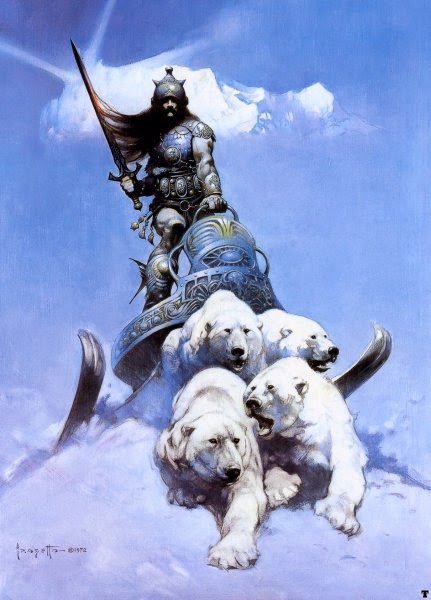
Inspired by Frazetta


I've recently been writing some of my personal stuff, for the first time in quite a while.  I revisited an old favorite setting of mine, and an old favorite character.  And that always puts me in mind of the art of Frank Frazetta.  Art has been important to me, inspiring me a great deal in my writing.  And from early on, Frazetta's stamp has been all over my mind's eye.  So, for little reason beyond that, I figured I'd share a few of my favorite paintings by the master.


-Matt

Saturday, November 1, 2014

Dork Art: Frazetta's Conan

I've been thinking a lot about Frank Frazetta and his amazing artwork recently.  Of course, that gets me to thinking about Conan and wanting to go back and read some of my favorite stories.  Red Nails, Queen of the Black Coast, The Frost Giant's Daughter.  Love it all.


Will we ever get a film that does Howard justice?  I'm not holding my breath, but I can dream.

-Matt

Friday, August 1, 2014

Comic Review: The First Kingdom: The Birth of Tundran


    Admittedly, I’ve never been ‘in the know’ about comics.  While I tried them briefly as a wee lad, I didn’t stick with them, only returning to the medium in my late 20s with Hellboy, Tom Strong, and Metabarons.  However, I’ve always been friends with comic readers, and I’ve often been aware of various books and events in the industry, even if just in passing.  Also, what little interest I ever showed tended to be toward independent, sci-fi/adventure comics.  Yet, somehow, I’d never heard of Jack Katz and his The First Kingdom.  Having been a contemporary of several famous names, including Alex Raymond, Jack Kirby, and Stan Lee, I feel like I should have been more aware of the man and his work.  Anyway, now I am, and I’m glad of it.


    The First Kingdom is not a perfect book, nor is it going to appeal to the average, contemporary comic reader.  There is an old style, similar to that of classic newspaper strips like Flash Gordon or Terry and the Pirates, with a bit of 60s Marvel thrown in.  Sometimes the captions go on and on, and sometimes the word choices are peculiar to say the least (and I’m fairly certain, not always correct).  But this all lends it a strange quality that works here more than it does in something like early issues of The Fantastic Four or Challengers of the Unknown.  The writing style, along with the story itself help to give the whole thing a feeling of a grand myth cycle, like something out of ancient Greece or Scandinavia, or out of Tolkien’s Silmarillion (except this is readable) or The Bible.  You could also argue that Katz’s art has a tendency toward repetitiveness.  It is true, that many of his people look essentially the same, and on occasion I’ve had difficulty keeping one separate from another (especially his females).  And panels and pages often feature lots and lots of characters simply standing around, talking.  However, when the action does break out, when he does exercise his creativity, it can be gorgeous.  His environments and creatures are top notch.  And for those who are upset by the human body, you should know that the book features a good deal of nudity.


    The story is wonderfully grand and operatic.  Long after Earth was burned up in a nuclear war, humanity’s descendants are on their way up again.  Strange gods meddle with their affairs, while a young man breaks with tradition and sets off on a quest to give his people a new and permanent home, but he is destined to meet a violent end.  Epic quests, sinister villains, dangerous monsters, and fickle fate.  The stuff of mythology.  Odd bits of science fiction mix with copious amounts of fantasy, making me again think of the old Flash Gordon strips, as well as the works of people like Edgar Rice Burroughs.  So, while I don’t know that the general comic reader would appreciate this work, I think that fans of Golden Age science fiction, of pulp adventure stories, or of movie serials might really like it.


    I, for one, am excited to find out what happens next in this grand imaginary history.  Many forces are coming together into what should prove to be a dramatic conflict.


The First Kingdom: The Birth of Tundran
Author/Artist: Jack Katz
Publisher: Titan Comics
ISBN: 978-1-78276-010-8

-Matthew J. Constantine

Wednesday, May 28, 2014

Dork Hero: Shane Rimmer


    One of the great ‘That Guy’ actors, Shane Rimmer has been a staple supporting actor for more than 50 years.  Recently, you might remember him as that guy in control of the waterworks during the climactic battle in Batman Begins.  But go back through the years and you’ll find him popping up in such gems as Space Truckers (“Square pigs!!!”), Out of Africa, Superman II & III, Doctor Strangelove, even Star Wars and three Bond films (as three different guys).  Originally from Canada, he’s spent much of his career in England, frequently playing the American.  He’s got a darned jovial face, and always adds a little something extra to a film.  The perfect quality of a ‘That Guy.’


Five Favorite Shane Rimmer films:
5.  Rollerball
4.  The Spy Who Loved Me
3.  Space Truckers
2.  Doctor Strangelove
1.  The People That Time Forgot

-Matt

Monday, May 26, 2014

Dork Hero: Peter Cushing

Like many of my generation I first became aware of Peter Cushing late in his life, as Grand Moff Tarkin, the real villain of the first Star Wars film (Vader was just a lapdog for Tarkin).  But I quickly saw him in several other films, and realized that he was quite the cool old dude.  As I transitioned into my teen years, he was my gateway drug, getting me hooked on the world of Hammer Horror.  I remain a junkie for bodice ripping, Gothic tinted, British horror/weird films.  Today is the 101st anniversary of his birth.  A tip of the hat to one of the great gentlemen of film.


Five Favorite Peter Cushing Movies:
5.  Star Wars
4.  At the Earth's Core
3. The Curse of Frankenstein
2.  Twins of Evil
1.  She (1965)

-Matt

Tuesday, March 25, 2014

Comic Review: Nemo - Heart of Ice


    League of Extraordinary Gentlemen is right up there at the top of my list of favorite graphic novels.  It taps into all those things I love so much, the wide array of Victorian and pulp adventure fiction, from H.G. Welles, to Jules Verne, to Edgar Rice Burroughs, and beyond.  And of course, one of the coolest characters was Captain Nemo, master of the Nautilus, dashing, suave, and deadly.  With Nemo, we follow his daughter, haunted by his shadow and his deeds, as she tries to find her own path in life.


    In 1925, Princess Janni Dakkar, the new Nemo, lives as a brigand.  When she runs afoul of Aisha and Charles Foster Kane, a chase across the world begins.  She blazes a trail across Antarctica and all the strange wonders it hides, from Present Land to the Mountains of Madness.


    If you’ve read previous League universe books, you’ll know the drill.  It’s sad, dark, full of ugly twists on classic characters.  But it’s also thrilling and strange, and challenges the reader to figure out the reference.  I know there were several I didn’t get.  One of these days, I’m going to have to go back through the whole series with some annotations or something.  I know there’s stuff I’m missing, meaning I’m not catching.


    I’ve never been a huge fan of Kevin O’Neill’s art, but it gets the job done, and helps to set the whole uncomfortable vibe of Moore’s bent literature rollercoaster.  Moore is one of those writers I go back and forth on.  He’s written some of my favorite books, but he’s also written stuff I can’t even force my way through.  He seems like a colossal jackass, and possibly more in love with himself than his rabid fans are.  But he’s also good at capturing the magic of the classic fiction I love so much.  Heart of ice is surprisingly upbeat; still kind of a downer, but for this series, it’s relatively positive.  I could see this being a really nice companion series to the later stuff involving the League.


Nemo: Heart of Ice
Author: Alan Moore
Artist: Kevin O’Neill
Publisher: Top Shelf Productions
ISBN: 978-1-60309-274-6

-Matt

Sunday, December 29, 2013

Prodigal Son: Inspirational Films for Space 1889


                                                                    Part Twenty One

    I’ve been thinking a lot about various roleplaying games recently, particularly about cinematic inspiration in relation to games.  I’ve already written a few articles about this, tackling player character groups, as well as specifically Call of Cthulhu and Ars Magica.  I thought this time I’d branch out a bit and do a slightly more obscure game, but one I like the setting for quite a bit.  This time around, I’m going to look at ten inspirational movies for the game Space 1889, a ground breaking early example of what would become Steampunk.

10.  Journey to the Center of the Earth (1959):  An excellent cast of characters goes on a wild adventure into the heart of our own world, discovering strange secrets, hints of ancient civilizations, weird pre-historic creatures, and dangers undreamed.  Victorian morality, self-motivated adventure, and hints of deeper history make this an especially charming tale.  (See also; At the Earth’s Core).


9.  The Jungle Book (1994):  British Colonialism meets native life in this classic tale of West meets East in India.  This film could be translated almost directly to one of the canal cities of Mars.  The British officers, their relationships with the locals, even the plot would all work.  In many ways, though the weather is different, Mars is the India of Space 1889.  (See also; Gunga-din).


8.  The Time Machine:  The Victorians were all about exploring and inventing.  In this tale of an inventor who rockets himself into the future, we see the perils of war and the potentials of Darwin’s dangerous idea.  The Time Traveler is a perfect character for Space 1889, even if he can’t get that particular machine to work (and goodness, what if he could).  (See also; The Golden Compass).


7.  The Prestige:  The darker side of invention and the wild showmanship that really came into its own during this time.  Mad science, mysticism, and the obsessions of driven men.  Plus, Tesla.  Thomas Edison plays a large role in Space 1889, but what if Tesla was luckier or craftier?  What if Tesla and Edison became epic and powerful rivals?  What would Tesla be doing in space?  (See also; The Illusionist).


6.  Sherlock Holmes (2009):  This more earthy, grimy rendition of Arthur Conan Doyle’s classic mad genius is my favorite cinematic version, and just behind the Jeremy Brett TV version for all time favorite.  Here we see the world of the late 1800s in all its dingy, ugly glory.  Fast paced adventure that recaptures the pulpy aspect of Doyle’s work that has generally been lost in previous film versions, and excellent renditions of the various characters make for a very charming whole.  The Holmes-Watson relationship is one of the best, most honest friendships I’ve seen on screen, and the fact that Watson’s fiancé isn’t  relegated to nagging harpy was a pleasant surprise.  She’s got all the pluck (if not the screentime) of a good heroine.  (See also; The Wolfman [2010]).


5.  20,000 Leagues Under the Sea (1954):  This action packed adaptation of the Verne novel features an excellent cast and amazing production design.  Once again, the issues presented could translate either directly to Earthly seas of Space 1889, or with very little work, into some area of the solar system.  Captain Nemo might be a disenfranchised native of Mars who flies an advanced ship through the either, blasting other ships in a protest against England’s continued expansion of influence.  (See also; Atlantis The Lost Kingdom).


4.  John Carter:  Though it fails to capture much more than the barest fraction of the magic of Edgar Rice Burroughs’ novels, this film still visualizes some of the things that were obviously influences on Space 1889, including the Barsoom air ships.  Mars itself has a lot of the right look and feel, if you just put more fins and bat features on the Red Men, they’d make pretty good Martians.  The deep history implied in the film captures some of that ambiance, too.  (See also; First Men in the Moon).


3.  The Ghost and the Darkness:  Life on the frontier, building outposts of civilization can be difficult and dangerous.  It takes people with a lot of nerve and maybe too little smarts.  Capturing some of the societal situations of the day, this historically inspired yarn of killer lions also cranks up the mystery and horror.  (See also; The Mountains of the Moon).


2.  The Mysterious Geographic Explorations of Jasper Morello:  A creepy animated story of plague and lost love, this film feels more like the tales told by children in the slums than an actual Space 1889 story.  But don’t those tales usually have a grain of truth in them?  A very creepy and dreamy film.  (See also; City of Ember).


1.  The Man Who Would be King:  Daniel and Peachy are fantastic Space 1889 characters; men ready to take on the world, looking to make their fortune, and just about mad enough to pull it off.  A beautiful epic of two mad bastards putting their mark on a mysterious land.  (See also; She).


    There have also been a few TV shows over the years that capture at least something of the spirit of the game.  The Secret Adventures of Jules Verne was deeply, deeply flawed, but did have some cool elements.  The Adventures of Brisco County Jr., as well as the original Wild, Wild West give the American West a steampunk vibe that works pretty well with Space 1889.  The Amazing Screw-On Head was the pilot for what could have been a great show.  And the Sherlock Holmes TV series starring Jeremy Brett is quite excellent.


-Matt

Friday, November 29, 2013

Book Review: Icerigger


    When I was a lad, my father pointed me in the direction of some Alan Dean Foster novels.  I think he told me specifically about the Flinx and Pip books, which oddly I wouldn’t go on to read for two decades or more.  But none the less, I was fascinated by Foster’s Humanx Commonwealth, and I picked up a handful of books and read them over the years.  Among the first I bought were the Icerigger trilogy…which I again, didn’t read.  Until now.  I found the trilogy as ebooks on the cheap, and figured now was a good time.


    Icerigger introduces us to Ethan Fortune, a merchant looking to make a name for himself and get a cushy job back in the core worlds, caught up in a kidnapping attempt that quickly goes from botched to totally screwed.  Soon, he finds himself one of the survivors of a crash, marooned on a hostile ice world, with no expectation of rescue.  Here we meet, among others, the mad Viking of a man, Skua September.  In Edgar Rice Burroughs fashion, Fortune and September embark on a journey of discovery and adventure, involving inhuman natives, swashbuckling, politics, and romance.


    Foster’s Humanx novels are direct descendants of classic space opera, mixing the pulpy fun of Burroughs’s Mars books and C.L. Moore’s Northwest Smith stories, with the huge scale universe building of Asimov’s Foundation and E.E. “Doc” Smith’s Lensmen.  Similar to Larry Niven, A. Bertram Chandler, and others, he crafted a wide, wild universe to play in, creating galaxy spanning civilizations and local potentates.  Though the action of Icerigger is limited to one world (and briefly, it’s orbital space), you are constantly aware that events take place within a larger setting.  Fortune and September are certainly fun characters to follow.  Fortune is a relatable guy.  Smart, competent, and driven, he’s able to roll with a lot of punches, but still reacts in a way the reader can understand.  September is a wild beast of a man; a hard partier, lover, and fighter.  If I have a complaint about this novel, and I don't know that I do, it's that the story reaches a natural climax and conclusion, only to keep going.  It feels like the book is over, but there's a sort of novella tacked on to the end.  Odd, but not necessarily bad.


    Fans of space opera must check out Alan Dean Foster’s Humanx books.  If you’re only familiar with him from his incalculable number of movie novelizations, forget that and read some of his original work.  His universe is more consistent, and more consistently good than the Star Wars or Star Trek universes, while filling a similar niche.


Icerigger
Author: Alan Dean Foster
Publisher: Open Road Publishing
ISBN: (ebook) 9781453274088

-Matthew J. Constantine

Saturday, November 9, 2013

Dork Art: Austin Purser’s Travel Posters


    I love retro travel posters.  There’s a wonderful, hopeful exuberance to their simplistic and colorful technique.  They put me in a certain mood, a mood I enjoy living in.


    So, seeing these awesome retro-style travel posters to various literary lands and worlds is quite nice.  I think Austin Purser has captured the flavor quite well, and I like the variety of locations he’s chosen.


     Anyone looking for a Christmas present for this Dork could sure do worse (hint: I'd love to see Yuggoth this time of year).

-Matt

Monday, September 2, 2013

Book Review: Yes is the Answer


“This wasn’t rock music.  Was it?  It couldn’t be rock music.  It sounded like science.” -Joe Meno page 266

    I was probably 12 or so when I first heard Emerson, Lake, and Palmer.  I didn’t know what it was.  But I knew it was for me.  Considering how well adjusted I am today, it may come as a bit of a shock to readers that I was a pretty weird kid.  Thanks to parents with distinct and different musical tastes, and two much older brothers with different and distinct musical tastes, I grew up in a household filled with a multi-generational cornucopia of sound.  My mom’s taste was rooted fairly strongly in the 50s, with a dash of light classical.  My dad’s in the 60s, with dashes of I don’t even know what.  My brother Tom was into hard rock and punk.  My brother Bill was into psychedelic rock and blues.  And in what turns out to be a blueprint for my life, I sampled a bit of everything and came out with a jumbled mess of a bit from column A and a bit from row 8.  Give me the broken glass rage of Ministry’s Stigmata, the thunderous pomp of Wagner’s Gotterdammerung, the smooth sounds of Dean Martin, the tinny pluck of Josephine Baker, or the poppy awkwardness of Kate Nash.  I like a little of this, and a little of that.  And one of the things I like, I found out is called Prog Rock (Progressive Rock).  It was an attempt to take music in a new direction; it was the music that was going to carry us into the future.  And I never realized that like so much else in my life, it isn’t cool to like Prog Rock.

These guys seem pretty cool to me.

    But I didn’t know it wasn’t cool.  And I didn’t know it had a name.  I just knew that when I heard Brain Salad Surgery, my mind was totally blown.  I was just discovering the weird and wonderful world of fantasy and science fiction literature and art, with Michael Morcock, Edgar Rice Burroughs, Rodney Matthews, and Frank Frazetta.  And suddenly, it all had a soundtrack.  Soundscapes that carried me to other worlds, flying through ruins of ancient civilizations, battling impossible creatures and machines.  It was as epic as Beethoven, but plugged in.  And I mean plugged in.  It wasn’t just electric, it was cybernetic; like William Gibson’s black ice, hunting me inside my own mind.  To this day, I have never taken any kind of psychoactive drug (or anything stronger than flu meds).  But I feel like I floated through purple haze and ran with Lucy through fields of gumdrops.  When I popped in the cassette (much later, the CD), slid the giant headphones on like a knight's helmet, closed my eyes, and cranked it up…my mind expanded and I felt like the universe opened up.  Matt’s 12 (through 21) year old brain...Blew.  The f*%k.  Up.


    Turns out, I listened to a lot of Prog Rock over the years without ever really knowing it.  I just listened to things I liked.  I could never get into Yes, in the same way I could never get into Mozart.  They were fine on a technical level, but didn’t engage me on an emotional level.  Yet, like Mozart, it was fine to have on in the background.  I lost my taste for Pink Floyd because of the radio.  Genesis because of Phil Collins.  It would take nearly 20 years for me to sit in the Court of the Crimson King for the first time.  But that crazy, classically influenced, science-fiction inspired madness kept bringing me back.  I think perhaps it was because I grew up (musically speaking) after Prog had its day, I listened without baggage, without expectation.  I could hear a band’s entire output in an afternoon or day, and pick what I liked and what I didn’t, without having to wait a year for a new album; without having to face disappointment.  I didn’t have to live through member changes or directional shifts.  It was just there, laid out before me in toto (and yes, sadly even in Toto).  Growing up with such diverse musical tastes surrounding me, and never feeling connected to people my own age, I was used to being outside my own generation’s taste norm.  To this day, I just hate the 90s.  Yes, absolutely, there are some exceptions.  But musically, I think the 90s is one of the worst times in the history of ever.  It was the music of my high school career, and yet, it was never my music.  And while I eventually experienced a certain nostalgic joy with 80s music, even the stuff I used to hate, the 90s still exists as a psychic vampire, draining my hope and will to live.  There isn't enough bleach in the world to get rid of the Grunge.  So, I never had any kind of shame, or any idea that I should have shame, for loving Prog Rock.

Nothing amiss here.

    I bring all that up, because when I picked up Yes is the Answer, I was hoping to get a good solid understanding of the subgenre, its history, and its legacy.  But, for a good part of the book, what I got was sheepish, foot staring monologs on how ‘it was a different time, and I was young;’ diatribes on why Prog Rock sucks.  Admittedly, some of the essays are quite amusing, self-effacing, and biting.  Some of them also feature interesting glimpses into different times and different places.  The youngest writer seems to be about my age, the oldest somewhere between my brothers and my parents.  They come from places like Spain, England, and California.  But wherever or whenever they’re from, they seem to know that liking Prog Rock isn’t cool, something you shouldn’t admit, and its an embarrassing part of their neurotic pasts.  Each chapter is written by a different author, and their backgrounds are very disparate.  Male and female (though, as almost every writer points out, heavily biased toward the male side), some were in bands, some journalists.  Many are novelists.  But most of them have one thing in common, they don’t like Prog Rock.  Most of them did at one time, or knew someone who was really into it.  Only a couple seem to enjoy it in any way now.  And that’s sad.

Chicks dig a flute player in makeup, right?

    If you’re interested in essays about how music effects our lives in countless ways, about the scene in the late 60s through the early 80s, about growing up and burning out, coming to terms with age, this is a good read with some sad bits, some angry bits, and a lot of very funny bits.  If you’re looking for a celebration of an over the top and grandiose subgenre of music we now call Prog, this ain’t it.   Most of the essays are well written and fast moving.  A couple turned out to be slogs.  And I did get some interesting history, as well as a few new bands to check out.  But it’s overall a mixed bag, and not just because it’s an anthology of essays.  While not nearly as rage inducing, the book smacks of hipsterism, which is the pop-culture equivalent of Communism in the 50s, so far as this cat is concerned.  I can't really recommend it, but I wouldn't advice against reading it either.


Yes is the Answer and other Prog Rock Tales
Editors: Marc Weingarten & Tyson Cornell
Publisher: Rare Bird Books
ISBN: 978-0-9854-020-1

-Matt