Showing posts with label Dust Bowl. Show all posts

Sunday, March 23, 2014

Matt’s Week in Dork! (3/16/14-3/22/14)


    This week is a bit of a blur.  In the aftermath of filming, I went into a slightly more funky funk, combined with some unrelated stress, and just didn’t have my mind on the Dork Life.  Still, there were bright points, to be sure.


Star Trek Into Darkness:  Upon second viewing, I find this film both better and worse.  On the one hand, I find a lot of things that I really enjoy.  Little bits of dialog, sequences, or production design.  But I’m also more bothered by how much better it not only could have been, but absolutely should have been.  Kirk is made into a horrible, sniveling, weak-willed little child.  Spock is a whiny a-hole.  Uhura has become a shrewish nag.  And the unnecessary villains are bordering on mentally enfeebled when it comes to plans and schemes.  At almost every turn, the writers had chances to make a very interesting movie, that continued to take the new timeline Trek on its own course.  Alas, at every turn, they made silly call-backs, rehashed old characters and plots, and on more than one occasion bent plot and story out of whack, just to do something stupid.  If Harrison wasn’t Khan?  Better film.  If Khan and Kirk teamed up, then went on their separate paths?  Better film.  If it had been a dilemma to solve, not a villain to punch?  Better film.  If Carol Marcus wasn’t involved?  Better film.  If the Klingons weren’t involved?  Better film.  And didn’t they already do the Admiral Robocop storyline in Star Trek VI?  I mean, why rip off both Star Trek II’s plot and Star Trek IV?  Anyway, this ultimately aggravating film has a ton of potential, but drops almost every ball it tries to juggle.  After such a good start to the re-launched series, this stumble feels catastrophic and probably terminal.  My interest in the franchise dropped down to the levels Star Wars has been enjoying for the last fifteen years.  And that ain’t good.


Alice Adams:  Katharine Hepburn plays a somewhat spoiled daughter of a struggling middle class family, who, along with her mother, is a bit obsessed with being perceived as part of the more sophisticated upper class.  What follows is an enjoyable light comedy of manors and misunderstandings.  Nothing too heavy.  One thing I find odd/interesting is the politics of race in the film.  You see racism, and there is certainly a character that seems like a racist archetype when you first see her.  But, it seems like the movie is lampooning racist assumptions and behaviors.  Or is it?  I’m removed enough from the time period that I’m not quite sure.  Was it subversively forward thinking, or am I giving them too much credit?  Overall, I really liked the movie, even though Fred MacMurray was the romantic lead.  Though his boring stiffness may have been to the benefit of the picture.


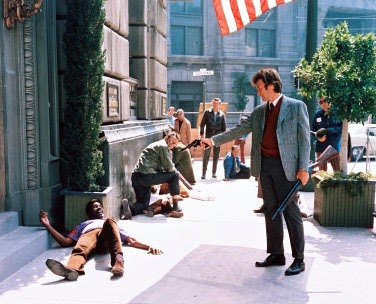
Dirty Harry:  One of the great pieces of 70s sleaze.  One of the best anti-hero cop films.  Dirty Harry is pretty much a rehash of Bullitt, but 100% more entertaining.  Clint Eastwood grimaces and sneers his way through life, hating the world and every piece of scum in it.  And when a giggling whack-job with a rifle starts picking people off, nothing is gonna stop Harry from getting his hands dirty, with punk blood.  No pointless romance sub-plot.  No great moral victory.  No personal growth.  Just hard, mean, ugly business.  A great score, fantastic footage of San Francisco, and some memorable lines help cement Dirty Harry as a landmark in cynical cinema.

    Because I’ve had a hard time focusing on reading lately, I paid a lot more attention to the music I had on during bus trips this week.  I really got into St. Vincent’s new, self titled CD.  After a few listens, I give it an enthusiastic thumbs up.  Very good.


The Astronaut Farmer:  This is a great family movie, about a family working together to realize dreams.  In a lot of ways, it felt like a film from the earlier 1980s.  Another case of ‘they don’t make movies like this anymore.’  It’s heart warming, gentle, and seriously enjoyable.  It’s got plenty of ‘that guy’ actors and lots of solid character performances.  Heck, even the kid actors are good.  This is the kind of thing I can imagine inspiring little kids to reach for the stars, and we could certainly use more of that.  Matt’s Family Seal of Approval.


The Grapes of Wrath:  The Great Depression shot by John Ford?  Normally, that idea would not thrill me at all.  But this adaptation of the classic novel of one of America’s darkest times is engrossing, entertaining, and ultimately uplifting.  Though the end sugar coats the book’s message, I find its hope filled look off into the distance of time to be satisfying.  The movie looks great, with some excellent faces and the desperate human misery of displaced peoples in stark black & white.  The acting tends toward the theatrical, but as the film takes on an almost mythic cast, that’s not such a bad thing.  Watching it made me want to dip back into HBO’s Carnivalle and follow it up with Sullivan’s Travels.  I’ve got a week off coming up.  We’ll see.


    Thursday night I watched the first disk of The Waltons.  Man, I hated that show when I was a wee lad, but I find it charming and fun now.  It’s wholesome and perhaps a bit saccharine, but it’s also refreshing and pleasant.  I know that over the course of its near decade run (plus several movies) the characters grow and experience snippets of history (from the Depression through WWII), and I find that interesting.  I may be sitting down for a long haul, watching the entire show.


The Call of Cthulhu:  I still find myself enjoying this darned faithful adaptation of H.P. Lovecraft’s classic story.  On a limited budget, they attempted to recreate the silent movie era, and for the most part, it works.  Not even close to my favorite Lovecraft tale, it’s still nice to see some of the author’s essential content make it onto the screen, something so rare in previous purported adaptations.  It makes me more and more hungry to see a faithful adaptation of The Shadow Out of Time or of course, At the Mountains of Madness.  Heck, a well made Shadow Over Innsmouth would still make me smile.


Legendary Weapons of China:  An excellent, probably way over-complicated martial arts adventure movie, Legendary Weapons of China is set in the latter days of the Boxer Rebellion (or just after).  It involved conflicted philosophies of martial arts and its place in society…and lots of fighting.  The tone is odd, with a good deal of goofing, but with some serious issues being discussed and fought over.  Yet, unlike some, it manages not to strike any notes too jarring for this viewer.  I enjoy hand to hand martial arts, but my preference is for weapon combat, and as the film’s name implies, this one features weapons.  Lots and lots of weapons.  Excellent.


    Saturday night was the latest meeting of the graphic novel club, where this month we discussed Brian K. Vaughn’s Pride of Bagdad.  The book left me cold upon reading it, but I did gain some appreciation for it, seeing it through some other readers’ eyes.  The art is nice, but it felt the most like when we read Get Jiro a while back; a bunch of potentially interesting ideas that didn’t go anywhere.


    I finally got back to and finished Philip Reeve’s Goblins.  It’s a fun children’s fantasy novel in the spirit of Lloyd Alexander’s Prydain cycle (see…or don’t…Disney’s boring adaptation of The Black Cauldron).  The fact that it took so long from the time I started to the time I finished is not a statement about the book’s quality, but my own scatterbrained funk and lack of focus I’ve been suffering for some months.


-Matt

Thursday, February 21, 2013

Book Review: The Vertical Farm


My non-fiction reading of late has mostly been in the realms of history or philosophy.  It’s been a while since I read a science book, and I think I was starting to feel the absence.  So, I grabbed The Vertical Farm off my shelf and jumped in.  It’s a crazy seeming idea.  Or is it?  Build skyscraper farms in the hearts of our urban centers.  Why not.  We need food.  We need jobs.  We need somewhere for our waste to go.  We need new ways of feeding the massive numbers of people on our planet.  Why not build up?  Is everything Dr. Despommier suggests possible?  Will it all work?  Maybe.  Maybe not.  He comes right out on multiple occasions and says that he doesn’t have all the answers.  What he and his grad students came up with are a bunch of ideas which seem like they might work.  They’ll take effort, money, expertise, etc. to put into practice.  But what he proposes doesn’t seem to be outside of our current technological or resource reach.  He’s not proposing something that relies on an assumed advancement that may or may not show up in the next few years.  The primary stumbling block for this sort of project seems to be will.  Are people willing to do it?


There really does seem to be potential for indoor farming, built within city limits.  The ability to control crops, to grow them clean, to reduce water use, waste, and soil depletion.  The potential ability to recycle waste and water, creating clean water.  The ability to reduce the agricultural footprint on the land, one of the largest sources of a multitude of pollutants.  And the potential to create a great many jobs in the places people want to be (cities).  Not to mention reducing the vulnerability of our food sources by decentralizing them and securing them inside, and the reduction in fuel consumption and wasted food that goes into getting harvests across vast distances to the people’s plate.  The potential benefits are quite astounding, and the potential problems, while not negligible, do not seem insurmountable.  But again, it comes down to will.  When you have a large part of the population of what was once one of the most advanced cultures on the planet claiming that the environment is perfectly fine and that nothing we do can really damage it, in spite of incalculable amounts of evidence (and common sense) to the contrary, simply because their sports team (I mean political party) tells them that’s what they should think, I don’t have the greatest faith that the will to lead the world in technology and culture is in the heart Americans anymore.  I hope I’m wrong.  And I know there are plenty of us out there who genuinely think things can be fixed, made better, and advanced again.  If only the petty tribalism and superstition can be cast off, there’s no telling what we could do.


In this book, Dr. Despommier sells his heart out on this idea.  He clearly believes in it, believes it can lead the way to better, healthier, and more sustainable food production for all the world’s people, even the several billion expected in the next couple decades.  But he admits, it’s an idea.  It needs to be tested, tried, explored.  There will likely be problems he and his people have not foreseen, but there may also be additional benefits, new options and possibilities opened by experimenting.  What is sure is that we need to eat.  Traditional farming can not sustain our current numbers for long, and can not sustain our expected numbers at all.  Pollution levels are building up to potentially catastrophic levels.  And one day soon, something will change.  Instead of waiting for that to happen, and then suffering the consequences, he proposes we meet that change on our own terms, direct the way things go in a more thoughtful and logical way.  Nature is amazingly resilient.  As he points out, there are numerous instances where, once left alone, nature has repaired itself in much quicker order than people expected (the Dust Bowl’s rebirth, forests in the North East US, etc.).  But the key is leaving nature alone to fix itself.  That means more self-sustaining (so called ‘green’) cities.  Better public transit, better food distribution, better resource management, etc.  (I always find it funny that so called ‘conservatives’ are the most liberal about wasting resources.  Every old-timey person knows you don’t shit where you eat [pollution], and you don’t waste what you don’t use).  It means an end to farming techniques that have been used and abused since we first stopped roaming the grasslands.  It means learning from our mistakes and doing it better.  And it means finally admitting that we’re taking a hand in the shaping of ourselves and our world, and we should act accordingly.


It may be up to more forward thinking, or more wealthy and experimental nations to break this new ground.  Though that saddens me, like space exploration, I’ll take what I can get.  If it’s Dubai, Germany, or China, someone’s going to need to do something soon.  I wish it would be the United States.  Fifty or sixty years ago, before the religious right’s devastating war on science and reason, it would have been.  But now science is feared, facts ignored, and ignorance is celebrated as a virtue (it even has its own genre of music, sinisterly called Country).  No wonder we have one of the highest infant mortality rates in the developed world.  When a sizable portion of the population not only believes in, but looks forward to an apocalyptic ending of the world (they can keep looking forward to it until the Sun finally expands in another what, six billion years?), how can you get them to plan for the future and for future generations?  But again, like with space, someone else doing it is better than it not getting done at all.  I want to be proud of American advancement in science, technology, and exploration.  But I’ll accept being proud of human advancement in all three.


The book, in its conversational tone, is meant as a discussion starter.  He isn’t giving all the answers, but posing open ended questions.  He isn’t saying, “this is THE answer.”  He’s saying, “this might be AN answer, let’s give it a try, or come up with something better.”  He doesn’t ignore the idea of profit, or of  our less than altruistic motivations, nor does he condemn them.  We are the creatures we’ve evolved to be, and part of that is our hunger for more.  As is being learned more and more, doing things for the greater good of all does not mean giving up personal gain.  Quality of life today and in the future should be important to all of us.  This book is a call to action, to fix or let nature fix, the mistakes of our past, and to learn from them.  It’s time to change the way we farm.  Time to change the way we feed ourselves and others.  Time to stop being a slave to the whims of the environment, and time to stop being an agent of destruction in that environment.  There is plenty of room on this Earth (and possibly on countless other worlds), and we have the tools to live together.  We only lack the willingness to do it.  Read the book for a boost of hope and for some ideas.  It’s a starting point, not a finish.


The Vertical Farm: Feeding the World in the 21st Century
Author: Dr. Dickson Despommier
Publisher: Thomas Dunne Books
ISBN: 978-0-312-61139-2

-Matt